

Resiliency

Impressions from a Month in France and Scotland

Climate and Resilience Issues Are Being Addressed in Impressive Ways

This summer’s heat extremes in Europe have set new temperature records, spread wildfires, and created public health issues. Fifteen thousand people died in France during the August 2003 heat wave. This summer, with even higher temperatures, no one has died in France. Big numbers have died in other southern European countries where there have not been the same kind of measures taken to protect citizens. The French government has created a comprehensive heat emergency plan as part of a larger scheme to address climate change and boost climate resilience. 

Swimming pools, bathhouses (dating back to the period before many French had bathrooms at home), and parks are open daily and with hours extending to almost midnight. Misting machines in parks, plazas, and other public spaces, often tied to fire hydrants, are set up to cool these areas and create fun places for children to play. “Heat wave kits” are sent to parents for their children and to older, at-risk people.

There is also a push to ban cars in French cities and make public transportation free during temperature spikes, but this has not turned into official policy yet.
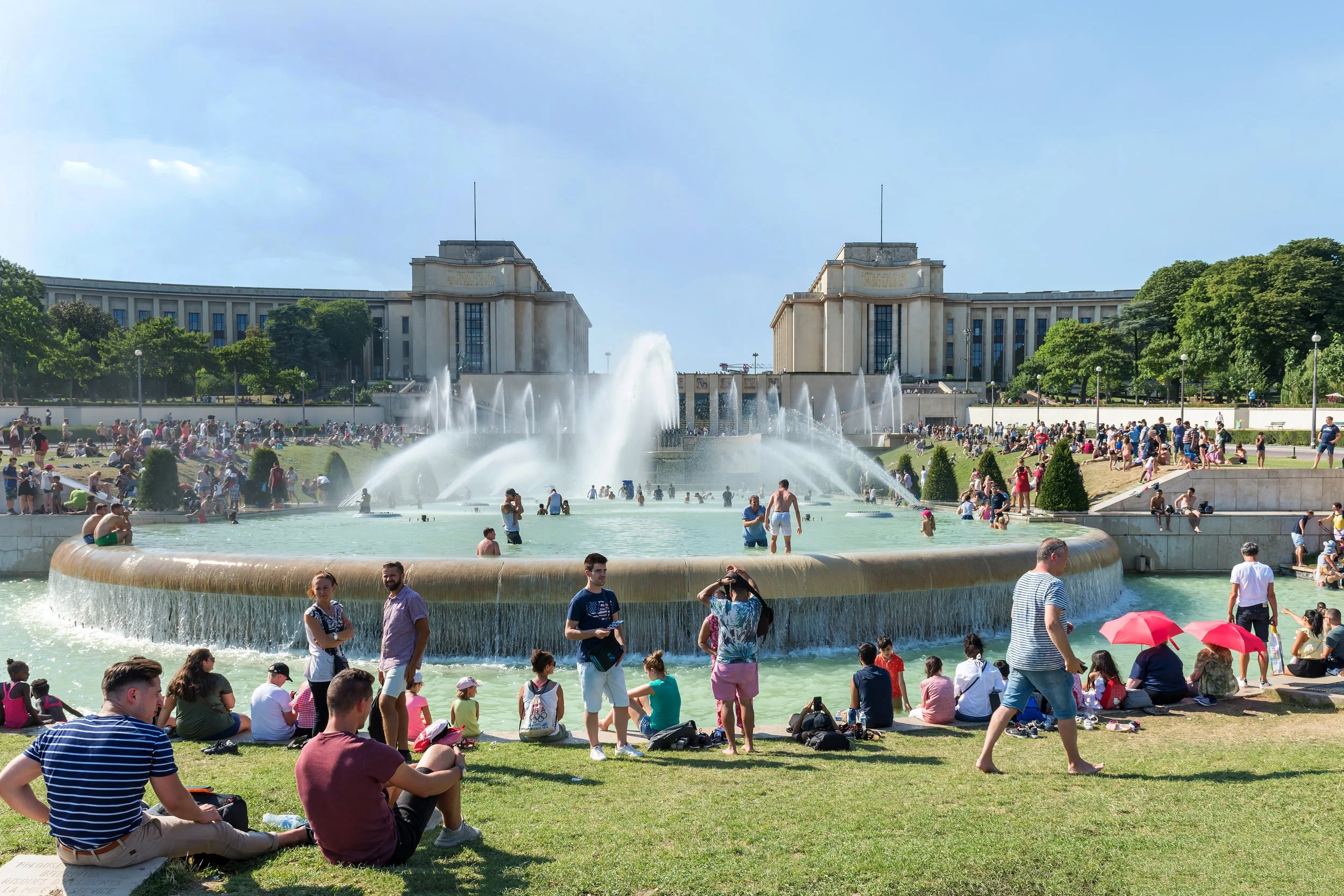
The heat island effect makes French cities as much as 18 degrees Fahrenheit hotter than the rural hinterland. To counter this phenomenon, streets and sidewalks are being made more porous, thousands of urban trees are being planted, and roofs are being transformed into green, vegetated coverings. According to Le Parisien, a national newspaper, the temperature can differ 90 degrees F between an asphalt-topped roof and a green roof.

In Britain, railway engineers were painting iron train tracks white to reduce temperatures by 10-15 degrees F and minimize buckling. 

Circling back to climate change, Scotland set a target of 100 percent renewable electricity by 2020; they hit 97 percent. Wind generators contribute the major component of this renewable power, 66 percent of it from offshore wind farms. Although wind towers dot the Scottish countryside, careful siting prevents view corridors or protruding above ridgelines. Perhaps because of Scotland’s long history of civic involvement, the Scots have done better than the French in taking aesthetics into account when locating wind turbines. 

Scotland is finalizing a development formula by which local communities will get a percentage of the returns from wind generators and other renewables for education, health, and affordable housing budgets. One sees almost as many solar panels in Scotland as in Southern California, despite their far north latitude. Ocean current, tidal, and bio waste also factor into their clean energy mix


Sustainable Flooring Options

What properties, besides cost, warrant consideration when considering flooring choices? Health issues such as toxicity or the avoidance of bacteria, dust and allergens need foremost attention. Health concerns should disqualify carpeting. Although there are eco-friendly choices for carpeting, such as wool, sisal, P.E.T. Berber (made from recycled plastic bottles) and carpet tiles, none of these avoid the inherent problem with all carpeting: the trapping of dirt, mites, pesticides and chemicals tracked in from outside. The AIA (American Institute of Architects) did a study some years ago, weighing newly installed carpeting that was steam cleaned weekly over its 10-year life and weighing it again when pulled up. Despite the rigorous cleaning schedule, it weighed 3 times its original weight. No cleaning method can completely remove the dirt and bacteria that get ground into carpeting.

If we rule out carpeting, what are other good choices? Wood flooring is one. Durability, recycled, reclaimed or renewable material, and transportation distance are key criteria for environmentally-friendly flooring. Taking these measures into account, wood flooring rates high. Solid wood flooring is not usually considered sustainable due to deforestation concerns, but wood from forests that are responsibly and sustainably managed and that carry the FSC (Forest Stewardship Council) certification guarantee negate any such worry. Reclaimed wood milled into flooring or, even better, reclaimed wood flooring is another way to get attractive flooring without logging existing forests. Then there is pre-finished, engineered wood flooring (FSC certified). Engineered wood is more stable than sawn boards, uses less wood per square foot, and avoids off-gassing when toxic-free adhesives are used. 

Although frequently considered along with wood flooring, bamboo is actually a rapidly growing grass and thus supremely renewable. Make certain the bamboo is mature, 4-6-year growth, because flooring made from 2-3-year-old bamboo is soft and scuffable. A variation, strand woven bamboo, has more of a wood grain look, is stable and extremely hard—twice as hard as oak. The only drawback to bamboo is that most of it comes from China, requiring transportation half way around the world.

Concrete isn’t usually thought of as sustainable or as flooring. When made with a high percentage fly-ash mix, concrete becomes considerably greener. Fly-ash is a waste product from coal power plants that can be substituted for cement and greatly reduces its greenhouse gas emissions. Concrete slabs can be turned into beautiful, eco-friendly flooring through selection of score pattern, use of organic dyes and careful polishing—often being made to look like stone, tile or old leather. As finish flooring, it saves the expense and material needed to install another finish floor over it. Concrete flooring contributes to high-quality, indoor air.

Other sustainable flooring choices are: naturally cushioned, anti-microbial, sound and thermal insulating cork (bark from cork oak trees); linoleum made from linseed oil, cork dust, tree resins and limestone; and glass tiles made from recycled glass bottles.

Flooring can be beautiful, easy on the environment and promoting of good health and there is a wide variety of choices.


Building with Wood

For several decades there has been a debate in the building industry as to whether wood frame or steel frame construction is more sustainable—wood being a renewable material, while steel has recycled content, often incorporating 70-80 percent old automobiles. Perhaps the debate is finally being decided due to a panel technology called cross-laminated timber, CLT for short. Developed in Europe in the 1990s, it is only recently gaining popularity here.

A CLT panel usually consists of 3, 5, 7 or 9 layers of kiln-dried boards stacked in alternating directions, bonded with structural adhesives and pressed to form a solid, straight, rectangular panel. Surprisingly CLT has good fire-resistant properties: it is hard to ignite and once lit resists fire spread. Because the layers are oriented perpendicular to each other, the CLT panels are exceptionally strong, stiff, stable, relatively light weight and able to handle load transfer on all sides. They can be used for walls, floors and roofs in a single building system, or used interchangeably with other wood products.

Most commonly CLT panels are 40-60 feet long but can be as much as 100 feet. They are up to 18 feet wide and any thickness up to 20 inches. These panels are widely used in Europe, Australia, Canada and Japan. The possibility of large panels is revolutionizing how 10, 20 and 30-story buildings are being built. Currently an 18-story, 400 student residence (174 feet high) at the University of British Columbia is the largest CLT structure, but a 24-story tower is under construction in Vienna and a 35-story building in Paris is in the works. The most ambitious proposal to date is London’s CLT framed, 80-story Oakwood Tower.

Not only are CLT panels frequently made using small-diameter trees, but also can use less desirable wood from pest damaged trees, or even trees killed by wildfires, without compromising the panel’s overall integrity. These small, less-than-perfect inputs to panel manufacturing are leading to better utilization of forest resources. Pulling out small and medium sized timber, as well as dead trees, contributes to healthier forests.

Processing these culled trees into CLT panels, which then get incorporated into buildings, sequesters carbon from the atmosphere. CLT not only emits less carbon dioxide during the manufacturing phase but the finished buildings then help sequester carbon for longer periods. Scientists estimate that buildings made with these materials result in a 25-30 percent reduction in global warming potential compared to those made with traditional materials—concrete, masonry and steel.

Because they lend themselves to design versatility, fast installation, reduced waste and good thermal and seismic performance, CLT can reduce construction costs by up to 50 percent. Perhaps the biggest advantage, however, is sequestering carbon while creating healthier and more resilient forests.


Specifics for a Resilient House

Structural Considerations:

Meet or exceed current seismic codes for tie downs, lateral (sheer) bracing, masonry chimney supports, etc.

A building’s ability to flex and absorb vibration is as important as how strong it is when it comes to earthquake resistant design. Install expansion joints to allow a building to move without damage during seismic activity.

Fire Resistance:

Use non-combustible materials for the building shell: 3 coat plaster, cementitious siding, clad or metal frame windows, clay or concrete roofing tiles or standing seam metal roofing. Avoid exposed wood outside. If have exposed wood, coat with water-based intumescent paint.   Avoid attic venting [use foam insulation (Icynene) to meet code]. Consider metal gutters integrated with metal facia. Use gutter guards to keep gutters cleaned out. Since eaves are one of the most vulnerable areas, cover with non-combustible material like plaster or cementitious boards.

Make deck surfaces non-combustible with tile or masonry combined with plaster skirting and plaster or metal guardrails.

Make structure super tight to prevent/minimize smoke intrusion.

Top chimneys with ¼” mesh spark arrestors.

Install state-of-the-art flame and ember resistant foundation vents. Use similar vents for soffit, ridge and gable openings, if they exist, but try to avoid. Brands to consider are Vulcan, O’Hagin, FAMCO, Ember Out and Brandguard.

Establish defensible space around your home, by planting fire resistant landscaping, keeping trees limbed up and cleaning debris around the house. Absolutely no wood or other combustible material should be stored near the outside of your house.

Protect from Extreme Weather:

Reinforce structure to withstand severe wind loads (basically same steps as for seismic strategies)

Prepare for heavy precipitation and flooding. Use deep overhangs (suggest 24”) to keep much of the rain away from the house. Use gutters, downspouts, French drains, soil slopped away from structure and site swales, infiltration basins and catch basins to let water penetrate ground and protect the building from heavy storms. (Can use gutter system to capture and store rainwater for future irrigation).

Provide permeable surfaces at patios, walkways and driveways to absorb storm water.

Build drainage planes behind wall skins to allow trapped moisture/water to escape and drain out at base of walls.

Pay special attention to basements and crawlspaces where water may collect. Locate mechanical equipment and electric panels above grade. Attic spaces are ideal for such equipment (furnaces, boilers, AC equipment, and water heaters).

If located in a flood plain or the coastal zone, think about rising seas, storm surges and even possible tsunamis. Elevate the main living quarters and install breakaway walls at the lower level. This is standard practice in Hawaii.

For Survivability:

Employ passive solar design strategies. Create a tight shell with substantial insulation, thermal breaks, thermal mass, strategically placed windows, natural ventilation, stack ventilation, and moveable shading devices on the sunny sides of the house. Maximize daylighting. These steps can save operating costs and assure a reasonable level of comfort when heating/cooling equipment is out of commission.

Go All-Electric with Backup Storage:

Use Energy Star or better appliances or equipment. Use heat-pumps for heating, cooling, hot water and clothes drying. Install a magnetic induction stove for cooking. (Emergency back up for cooking could be a Coleman camp stove using propane cannisters). Generate your electric power with photo-voltaic panels and a backup storage system (maybe Sonnen-a German battery). Arrange your electric circuitry for survivability. Run your refrigerator, cooker, some minimal LED lights, your media/information center and at least one receptacle for charging phones off the battery backup system. A Yeti Tundra 65 cooler makes an effective emergency backup for frozen foods when power goes out.

Consider an electric vehicle or bicycle (electric or pedal) in case of an extended power outage where gasoline will not be available. Avoid a diesel generator for backup. Fuel may not be available plus it contributes to the climate crisis.

Develop an Emergency Water Supply:

Stored water, perhaps collected rainwater, can be purified/filtered with an MSR Guarding Purifier System.