

Communities

A Win for Housing, Livability, and the Climate

California Is Starting to Reverse a Century of Policy That Has Shaped Our Cities

Cities across America have suffered from sprawl, degraded urban design, poor walkability, high housing costs, and economic injustice. Many factors contribute to these urban ills, but UCLA professor Donald Shoup makes a cogent case that parking requirements in zoning ordinances are the main culprit. Per professor Shoup, such mandates subsidize cars, thus leading to more driving and car ownership. Looking at numbers nationwide, there are eight parking spaces for every car.

A few weeks ago, Governor Gavin Newsom signed into law a bill eliminating parking mandates for residential and commercial developments located within half a mile of major transit stops. Cities in California (and elsewhere in the country) are facing a growing affordable-housing crisis. This legislation is an important win for housing and parking reform advocates, because parking requirements raise housing costs, eat up valuable land, and make communities less delightful places. This act to remove parking requirements is the first statewide effort to prioritize people and their housing needs over cars.

Starting a couple of decades ago, Santa Barbara began taking some tentative steps to reform parking mandates. Casa de las Fuentes on West Carrillo is a 42-unit, affordable rental complex, designed for downtown workers. Instead of the standard two parking spaces per unit, it innovated with just one and charged $50/month to any occupant who owns or has leased a car. Unbundling parking from condo or rental living spaces needs to be universal. Even with only one space per unit, the Casa’s covered parking is usually only half full.

Eliminating on-street parking reduces car trips, especially when accompanied by increased public transit. Copenhagen has removed 2-3 percent of its street parking each year for more than a decade with growing improvements to its economy and livability. In the past year, Oslo has removed more than 700 downtown parking places and replaced them with bike lanes, pocket parks, and sitting areas. Oslo’s ultimate goal is a total ban on cars in the city center. In Paris, the pandemic led to the mayor accelerating the plan to remove 72 percent of on-street parking and speed up the creation of more bike lanes.

California’s new parking reform law is not only helping with housing affordability and neighborhood livability but also reducing air pollution and greenhouse-gas emissions. As we move to more electric vehicles, it is still important to remove parking requirements and increase the fees charged for parking. Such changes lead to fewer vehicles being manufactured and the conserving of valuable finite resources. Moreover, fewer parking spaces mean cars are less dominant in urban design. Hopefully this California innovation will spread to other states, as often is the case when California takes the lead.
Impressions from a Month in France and Scotland

Climate and Resilience Issues Are Being Addressed in Impressive Ways

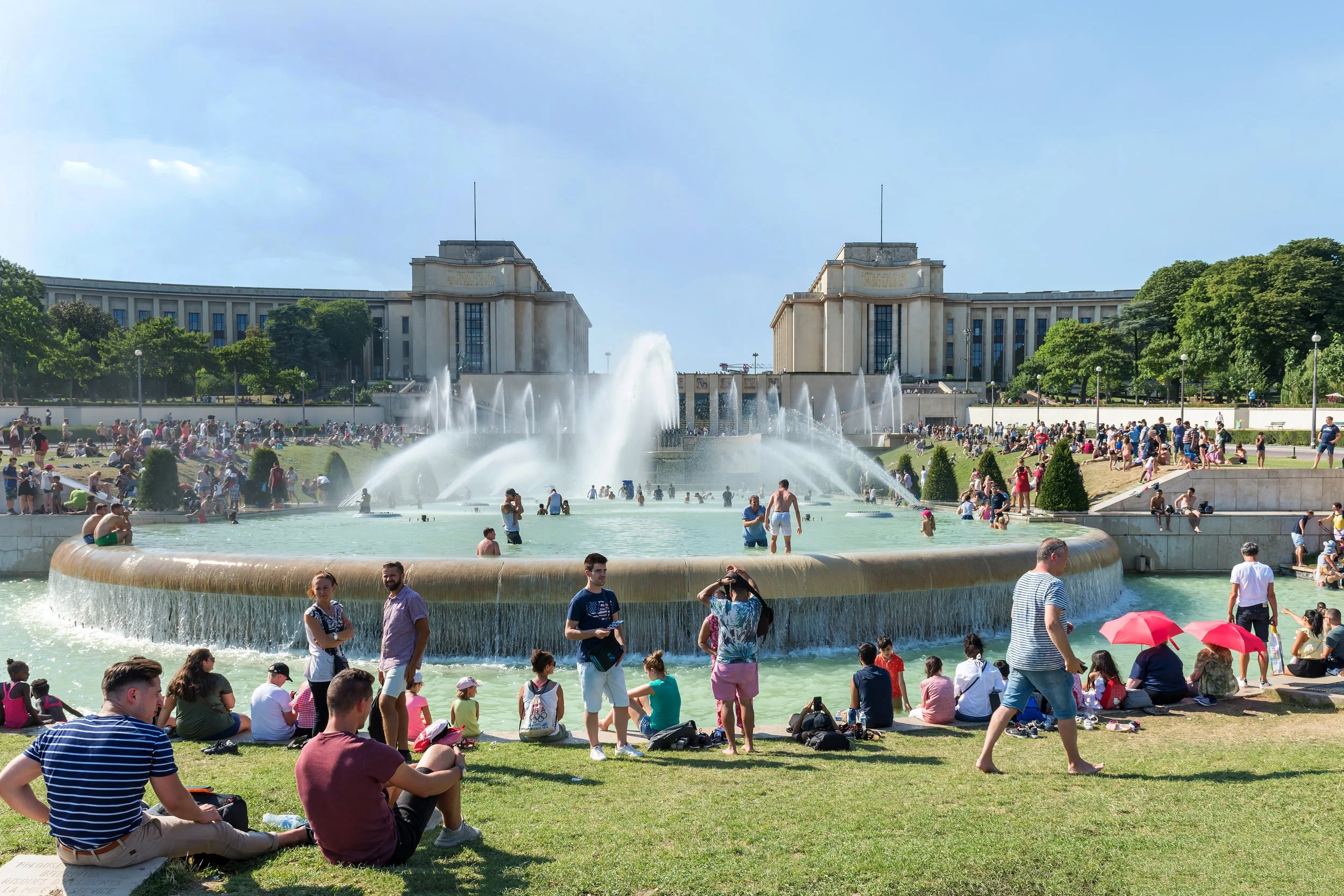
This summer’s heat extremes in Europe have set new temperature records, spread wildfires, and created public health issues. Fifteen thousand people died in France during the August 2003 heat wave. This summer, with even higher temperatures, no one has died in France. Big numbers have died in other southern European countries where there have not been the same kind of measures taken to protect citizens. The French government has created a comprehensive heat emergency plan as part of a larger scheme to address climate change and boost climate resilience. 

Swimming pools, bathhouses (dating back to the period before many French had bathrooms at home), and parks are open daily and with hours extending to almost midnight. Misting machines in parks, plazas, and other public spaces, often tied to fire hydrants, are set up to cool these areas and create fun places for children to play. “Heat wave kits” are sent to parents for their children and to older, at-risk people.

There is also a push to ban cars in French cities and make public transportation free during temperature spikes, but this has not turned into official policy yet.

The heat island effect makes French cities as much as 18 degrees Fahrenheit hotter than the rural hinterland. To counter this phenomenon, streets and sidewalks are being made more porous, thousands of urban trees are being planted, and roofs are being transformed into green, vegetated coverings. According to Le Parisien, a national newspaper, the temperature can differ 90 degrees F between an asphalt-topped roof and a green roof.

In Britain, railway engineers were painting iron train tracks white to reduce temperatures by 10-15 degrees F and minimize buckling. 

Circling back to climate change, Scotland set a target of 100 percent renewable electricity by 2020; they hit 97 percent. Wind generators contribute the major component of this renewable power, 66 percent of it from offshore wind farms. Although wind towers dot the Scottish countryside, careful siting prevents view corridors or protruding above ridgelines. Perhaps because of Scotland’s long history of civic involvement, the Scots have done better than the French in taking aesthetics into account when locating wind turbines. 

Scotland is finalizing a development formula by which local communities will get a percentage of the returns from wind generators and other renewables for education, health, and affordable housing budgets. One sees almost as many solar panels in Scotland as in Southern California, despite their far north latitude. Ocean current, tidal, and bio waste also factor into their clean energy mix


The Lompoc Strauss Wind Farm

Santa Barbara Is Well on the Way to 100 Percent Renewable Electricity

A small group of us had the privilege of recently touring the Strauss Wind Energy Project in Lompoc while it is under construction. It is the first and only wind project permitted anywhere along the California coast. From the first earlier permitted version of 65 generators, it has been scaled back to 27 machines, yet with the capacity to produce 100 megawatts of electricity.

Reducing the number of turbines has significant environmental and economic benefits. Major advances in “wind” technology during the past 10-15 years have boosted the output possible for a single generator. Each Strauss platform is rated at 3.8 megawatts, the largest land-based turbine available in the U.S. Blades are 227 feet long, the towers 492 feet tall. Scheduled completion date is December this year. Once operational, project will produce the electricity to power 45 thousand houses. For the next 30 years, it will keep six million metric tons of CO2 from entering the atmosphere and warming the planet. This is the equivalent of not driving 16 billion miles. In addition, it will infuse $40 million into Santa Barbara’s tax coffers.

The next wind project along the California coast will likely be offshore, either in the ocean off Morro Bay or off the coast of Humboldt. Both zones have received federal and state approval and are being readied for bulk permitting. The Biden administration recently approved a Massachusetts plan for the nation’s first commercial-scale offshore wind farm. A dozen other East Coast offshore wind projects are now under federal review. Unlike the East Coast, California faces the logistical challenges posed by a deep ocean floor. Evolving technologies, developed mostly in Europe, now make wind generators on floating platforms feasible, as well as even larger ones than land-based units. There is a wind farm with 6-megawatt turbines operating in the North Sea. There is also a 14-megawatt turbine that has been successfully producing for two years in Rotterdam Port.

Santa Barbara has set a goal of 100 percent renewable electricity by 2030. The adoption of community choice energy programs in the Tri-Counties, an initiative advocated and led by the Community Environmental Council, now has 1.4 million households getting at least 50 percent of their electricity from renewables, and many as much as 100 percent. All will be getting to the 100 percent goal by the end of this decade. The Strauss wind farm, when it comes online, will be a big component of local clean energy production.

Wind energy is an ideal complement to solar energy because winds tend to be strongest in the evening and at night. The distributed photovoltaic panels on buildings throughout the County together with the 40-megawatt Cuyama solar farm and the 100-megawatt Strauss wind farm will produce about two-thirds of the electricity Santa Barbara consumes. The county is well on the way to meeting its 2030 goal.

Vineyards, Sheep, and Ecosystem Health

Agriculture, Rather Than Contributing to Climate Change, Can Provide Drawdown Solutions

Regenerative agriculture, the basis of which is soil health, eschews plowing, diversifies crops, shifts from annual to perennial varieties where possible, uses cover crops, integrates animals, and incorporates productive trees. It achieves impressive results in varying degrees: biological diversity, human and animal health, plant vigor, and pollinator viability. Instead of producing greenhouse gases (one-sixth of global emissions arise from the farm sector), it sequesters carbon. Increasingly, farmers are transitioning to regenerative practices to retain more water in their soils, lower their costs, stop erosion, and get out of debt.

An innovative and promising example of regenerative agriculture is the 7,600-acre Paicines Ranch in San Benito County, California. In just one small corner of the ranch, a 25-acre organic demonstration vineyard was planted in 2017. It includes native perennial grasses and sheep. The aim is to combat climate change by sequestering carbon, minimizing water usage, and increasing healthy mycorrhizal soil fungi while making fruit to produce exceptional wine.

An increasing number of grape growers have stopped tilling for weed control; tilling exposes bare earth, releasing carbon into the atmosphere while heating and drying out the soil. Many even bring animals to control grasses and weeds and as a natural source of fertilizer, but only after the grapes have been harvested. The Paicines Ranch allows sheep among the vines even during the growing season. This practice is normally avoided because sheep can eat leaves, buds, and grapes.

To counter this risk, the owners designed the Paicines vineyard to have animals among the vines. Instead of training vines on wires near the ground within easy reach of grazers, their vines are trained onto higher trellises out of reach of sheep. The extra energy the plants need to push sap higher up is more than provided by the healthier soil. Another slightly older vineyard in Northern California’s Alexander Valley, following similar practices with integrated animals, recorded a 98 percent reduction in irrigation use together with significantly higher yields.

The first wine from the young Paicines vineyard is showing encouraging results. Some critics were impressed by the complexity from only four-year-old vines. The wine quality is critical to draw maximum attention to their unconventional farming methods.

Perhaps most important, the increased soil health and moisture retention from regenerative agriculture offer more of the resilience that farmers will need in dealing with increasingly volatile patterns of rainfall and drought. Industrial agriculture and overgrazing have increased heat, desiccated lands, and raised surface temperatures. Regenerative agriculture cools its environs. Records show surface temperatures can be as much as 2 degrees Fahrenheit lower. Soil temperatures can be many degrees lower when compared with bare soil.

The carbon-capture potential of regenerative agriculture is underappreciated. The quantity of retention is not fully known. A farm in Carroll, Ohio, had less than 0.5 percent carbon in its soil in 1978; today, this regenerative farm holds 8.5 percent carbon. Most regenerative farms don’t even get tested.